
Explore software / Salesforce Components / Automation Visualizer
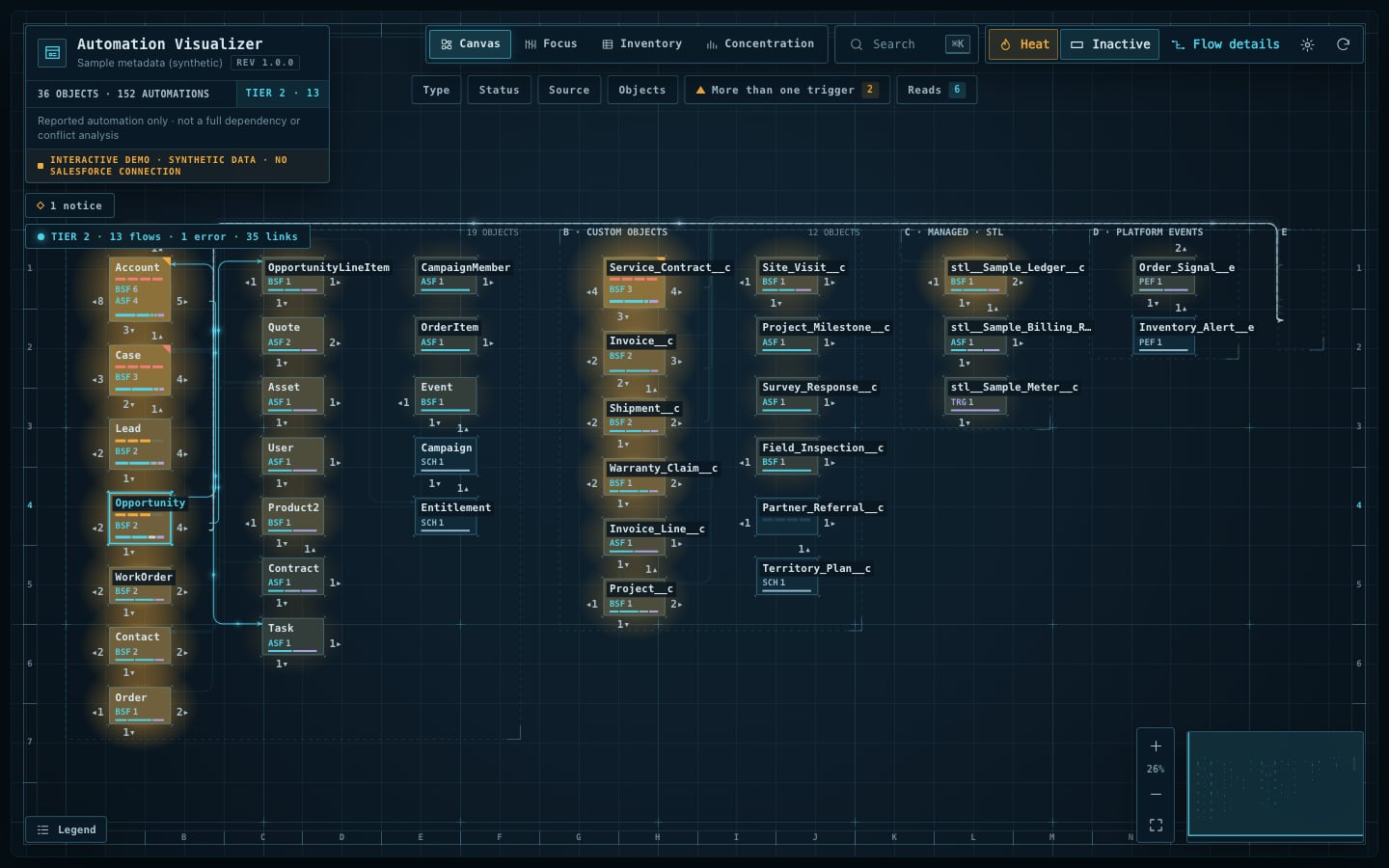
Real screenshots of the interactive demo: the component’s own rules on synthetic Salesforce records (every name is invented).
Salesforce Components · Productivity & Automation
Automation Visualizer
An automation blueprint for Salesforce: objects as modules, flows and triggers docked by phase, documented order-of-execution lanes, concentration heat and a spec-sheet inspector.
A full-width Lightning app on its own tab that reads the flows and Apex triggers Salesforce reports and draws the org as an engineering drawing sheet. Every object with automation becomes a module with its API name, a kind tag and a density meter. Before-save and before-delete flows dock on its left edge, after-save flows and legacy processes on the right, scheduled and platform-event flows on top and Apex triggers on the bottom with their seven event cells (BI AI BU AU BD AD AUD). Inactive automation is drawn hollow and dashed, and a delta mark shows a flow whose latest version is not the active one. Objects sit in districts (standard, custom, each managed namespace, platform events, unattached flows) and the layout never moves when you filter. Double-click an object and its automation moves into Salesforce's documented order of execution for insert, update, delete or undelete, with the steps the app does not read marked as such; it is the documented order, not a trace. A calculated concentration score drives a heat overlay and a ranked Concentration sheet with each object's breakdown. Flags call out more than one trigger on an object, flows without a trigger order, flows and triggers on the same event, invalid triggers and version gaps, each with its basis. The Inventory sheet lists every reported flow and trigger with sorting, filters and CSV export, a spec-sheet inspector shows each object, flow and trigger with Setup links, and a command palette (Cmd/Ctrl+K) finds anything. Optional Tier 2 reads the active flow versions' metadata through your own org's Tooling API, using a Named Credential your admin creates, to draw connectors for cross-object writes and subflow calls. Shows automation Salesforce reports through supported APIs. It cannot detect every dependency (e.g. Apex class logic, managed package internals, process builder internals not exposed, dynamic references) or predict execution conflicts.
- Lightning Web Component
- Lightning Experience
- Sharing, CRUD and FLS enforced
- Source code included
- Status
- In developmentVersion 1.0.0, built and unit-tested; not yet tested in a Salesforce org.
- Price
- $349 one-timeProposed price, not on sale yet.
- Installation
- Easy · about 20 minutesSalesforce CLI deployment with a step-by-step guide.
- Delivery
- Download · Salesforce DX sourceDeploy to your own org. Nothing runs outside Salesforce.
- Can I buy it?
- Not yetOpens after testing in a Salesforce org and owner approval.
The problem it solves
Admins and architects inheriting a Salesforce org rarely know what actually runs when an Opportunity or Case is saved. Setup spreads the answer across the Flows list, the Apex Triggers list, Process Automation and each object in Object Manager, one page at a time, with no view of where automation is concentrated, what runs before versus after the save, or which objects have several triggers whose order Salesforce does not guarantee. People end up building spreadsheets by hand before every change. Automation Visualizer reads what Salesforce reports and lays it out per object on one canvas.
What it does
- Automation blueprint
Every object with automation as a module with its API name, kind tag and density meter, grouped into standard, custom, managed, platform-event and unattached districts.
- Docked by phase
Before-save and before-delete flows on the left, after-save flows and processes on the right, scheduled and platform-event flows on top, Apex triggers on the bottom with their seven event cells.
- Documented order-of-execution lanes
Focus any object for insert, update, delete or undelete and its automation moves into Salesforce's documented order of execution, with steps the app does not read marked. Labelled as the documented order, not a trace.
- Concentration heat
A calculated score per object (before-save ×1, after-save and processes ×1.5, each trigger event ×1) with bands, an amber heat overlay and a ranked sheet showing each object's breakdown.
- Concerns with their basis
More than one trigger on an object, flows at the same point without a trigger order, flows and triggers on the same event, invalid triggers and version gaps, each with the Salesforce field it comes from.
- Active vs inactive at a glance
Inactive automation drawn hollow and dashed, a delta mark when a flow's latest version is not the active one, and filters that never reshuffle the layout.
- Spec-sheet inspector
Every object, flow and trigger as a spec sheet: type, trigger, DML events, trigger order, versions, namespace, last modified, position in the lanes and links to Flow Builder, Apex Triggers or Object Manager.
- Inventory with CSV
Every reported flow and trigger in a sortable, filterable, virtualised table; export the filtered rows to CSV with formula-injection protection.
- Command palette
Cmd/Ctrl+K searches objects, flows, triggers and commands; keyboard shortcuts for modes, heat, inactive and focus.
- Optional flow connections (Tier 2)
With an admin-created Named Credential, reads active flow metadata from your own org's Tooling API and draws circuit connectors for cross-object writes and subflow calls, each labelled with its source.
- Built for large orgs
Keyset paging, up to 10,000 flows and triggers, level-of-detail rendering and a cap message ("n of N loaded") instead of estimates.
- Honest by design
Shows only what Salesforce reports; nothing is inferred from names. A Setup panel lists what each user can read and what the app cannot detect.
Compatibility and installation
Built for
- Lightning Experience Its own tab or a Lightning app page
- API version 62.0 or later Every org on a current Salesforce release
- Designed for Enterprise, Unlimited, Performance and Developer Editions Editions that allow Apex deployment; not yet verified in an org
- View Setup and Configuration Users need it to read flows and triggers; granted separately by an admin
Data it uses
FlowDefinitionView, FlowVersionView, ApexTrigger, EntityDefinition, PermissionSetAssignment and NamedCredential (read, in user mode); optionally Flow metadata and MetadataComponentDependency through your org's own Tooling API (Tier 2). No records are written.
Installation difficulty
Easy, about 20 minutes. Deploy with the Salesforce CLI using the step-by-step guide, assign the permission set, make sure users have View Setup and Configuration, then open the tab. No code to write and nothing to configure for Tier 1. Tier 2 (flow connections) adds about 30 minutes of admin setup for an External Credential and Named Credential, following the included guide. Or book the installation service.
Not supported or not yet verified
- Salesforce Classic
- Experience Cloud sites
- Record pages (the app works at org level)
- Salesforce mobile app and tablets (not yet verified)
- Professional and Essentials Editions (no Apex deployment)
- Validation rules, workflow rules and duplicate rules (not read)
Verification pending. The component compiles with the Lightning Web Components compiler and its rules pass 73 unit tests; its Apex tests are written but it has not yet been deployed to a Salesforce org. Each environment will be marked verified only after it is tested there.
What you receive
- The Salesforce DX source: the Automation Visualizer app and its canvas, lanes, inspector, inventory, concentration, palette and setup components, the rules module and blueprint engine, an Apex controller and Apex tests
- The Automation Visualizer tab and permission set
- Deployment and removal manifests
- Installation, configuration, permissions, Tier 2 setup, security, performance, data and methods, and org test guides
- Version 1.x updates in My Software
Requirements
- A Salesforce org in Lightning Experience (designed for Enterprise, Unlimited, Performance or Developer Edition)
- A System Administrator, or someone allowed to deploy metadata
- The Salesforce CLI (free) or Visual Studio Code with the Salesforce Extension Pack
- View Setup and Configuration for every user (some orgs also require Manage Flow or View All Data to read flow definitions)
- Tier 2 only: an admin who can create an External Client App, Auth. Provider, External Credential and Named Credential
Changing it later
Settings are Lightning App Builder properties. You receive the source and may change it for your own org.
Limitations
- Not yet deployed or tested in a real Salesforce org; canvas behaviour under Lightning Web Security and Locker, and several setup-view behaviours listed in the org test plan, are unconfirmed
- Shows only automation Salesforce reports through supported APIs; it cannot detect every dependency (Apex class logic, managed package internals, process builder internals not exposed, dynamic references) or predict execution conflicts
- Without Tier 2 there are no connections between automations; Tier 2 needs an admin-created Named Credential and is off by default
- Validation rules, workflow rules, duplicate rules, assignment rules and roll-ups are not read; they appear in the lanes as "Not read by this app"
- Lanes show Salesforce's documented order of execution, not a trace; order within a lane is known only where Salesforce reports a flow trigger order, and never between triggers
- Process Builder rows and flow trigger objects appear only where the org's API reports them; otherwise flows are listed under Unattached
- The concentration score is a fixed, calculated weighted count of active record-triggered automation, not a measure of quality, risk or performance
- Loads at most 10,000 flows and triggers (5,000 by default); beyond the cap the app says "n of N loaded"
- Setup links use URL patterns Salesforce uses today; Salesforce does not guarantee them
- MetadataComponentDependency is a Salesforce beta and may be incomplete
- Salesforce mobile app and tablet behaviour not yet verified
Security and data access
- Read-only: the app writes no records and no metadata.
- Runs "with sharing" and every query runs in USER_MODE, so Salesforce enforces each user's object and field permissions; objects and fields are describe-checked and names validated before any query.
- Users need View Setup and Configuration, which the app's permission set does not grant; it shows nothing a user could not already see in Setup.
- Tier 2 is off by default. When an admin turns it on, callouts go only to your own org's Tooling API through your Named Credential (per-user or least-privilege integration principal); authentication is handled by Salesforce and the app never sees tokens.
- No third-party libraries and no external requests; no data is sent to Steadline.
Settings
Every setting is optional and is set in Lightning App Builder.
- Default view
- Canvas (default), Focus, Inventory or Concentration
- Default object
- An object opened in Focus on load
- Height
- 760 px by default on app pages (480–2000); the tab fills the window
- Show inactive
- On by default
- Heat overlay
- Off by default
- Include managed packages
- On by default
- Maximum automations loaded
- 5,000 by default, up to 10,000
- Tooling Named Credential
- Blank by default (Tier 2 off); the API name of your admin-created Named Credential
- Flows per Tier 2 run
- 100 by default (10–100)
Installation and documentation
- 1Unzip and sign in
Unzip the download and sign in to your sandbox with the Salesforce CLI (sf org login web).
- 2Deploy and test
Deploy with the included manifest and run AutomationVisualizerControllerTest: one sf project deploy start command.
- 3Give access
Assign the Automation_Visualizer_User permission set and make sure users have View Setup and Configuration. The permission set grants no record, field or system access.
- 4Open the tab
Open the Automation Visualizer tab. Optionally, an admin follows the Tier 2 guide to create a Named Credential and enters its name in the app page's properties.
Guides in the download
- Installation Deploy with the Salesforce CLI, run the Apex tests, assign the permission set, add it to a page, and remove it again.
- Configuration Every App Builder setting and what the component does with it.
- Security Sharing, object and field permissions, data read and written, and no external calls.
Optional services
- Installation service We deploy it to your sandbox and production, run the tests and add it to your pages.
- Customization Your own fields, rules or layout, quoted per project.
Quoted per project and not on sale yet. Ask about installation or customization.
Purchase and delivery
- Buy oncePay with Stripe. Steadline never sees your card.
- ConfirmedYour purchase is recorded only after Stripe confirms the payment.
- DownloadThe package appears in My Software with its SHA-256 checksum. Updates to version 1 appear there too.
- DeployFollow the installation guide, sandbox first.
$349 one-time · proposed
Not on sale yet: Built and unit-tested · Apex tests pass in a Salesforce org · Installed from the final package in a clean org · Price and license approved. Purchasing opens when all four are done.
License (draft terms, pending approval)
One purchase covers one Salesforce production org plus its sandboxes and scratch orgs. You may change the source for your own internal use. No resale, sublicensing, redistribution, or installing it for other organisations. Bug-fix updates to 1.x and email help with installation are included. If it cannot be installed in a supported edition and we cannot fix it, you can ask for a refund within 14 days; a refund ends the license. The final terms are shown before you pay.
Your license key identifies your purchase for support and updates. The component itself does not check it, does not phone home and has no activation step: it runs entirely inside your Salesforce org.
FAQ
Questions before you buy.
Is it a subscription?
No. It is planned as a one-time purchase (proposed price $349). You receive the source code and keep it.
Can I buy it today?
Not yet. It is built and its rules are unit-tested, but it goes on sale only after its Apex tests pass in a Salesforce org, it is installed from the final package in a clean org, and the price and license are approved.
Does it show every automation in our org?
It shows the flows and Apex triggers Salesforce reports to the signed-in user through supported APIs, up to 10,000. It does not read validation, workflow, duplicate or assignment rules, and it cannot see inside Apex classes or managed packages. Shows automation Salesforce reports through supported APIs. It cannot detect every dependency (e.g. Apex class logic, managed package internals, process builder internals not exposed, dynamic references) or predict execution conflicts.
Is the lane view what actually happens in a transaction?
No. It is Salesforce's documented order of execution, summarised, with your automation placed in each step. It is not a trace of a real transaction, and Salesforce does not guarantee the order between multiple triggers on the same object and event.
How is the concentration score calculated?
Active before-save and before-delete flows count 1, active after-save flows and processes 1.5, and each active Apex trigger event 1, rounded to 0.5. Bands: Light under 3, Moderate 3 to under 6, Dense 6 to under 10, Very dense 10 and above. Every number is labelled Calculated and the formula is shown in the app.
What permissions do users need?
The included permission set grants the app and tab only. Each user also needs View Setup and Configuration from an admin; some orgs also require Manage Flow or View All Data to read flow definitions. The in-app Setup panel shows what each user can read.
What is Tier 2 and do we need it?
Tier 2 reads the active versions' flow metadata to draw connectors for cross-object writes and subflow calls. It is optional and off by default, and needs a Named Credential your admin creates to call your own org's Tooling API. Everything else works without it.
Does it change anything or send data anywhere?
No. It is read-only and writes no records or metadata. Without Tier 2 it makes no callouts at all; with Tier 2 it calls only your own org's Tooling API through your Named Credential. Nothing is sent to Steadline.
How is this different from Setup?
Setup shows flows, triggers and objects on separate list pages, and Flow Trigger Explorer shows the record-triggered flows for one object and event at a time. Automation Visualizer shows all reported automation per object, flows and Apex triggers together, on one canvas, by phase, with active and inactive state, concentration and the documented order of execution per object.
Has it been tested in Salesforce?
Not yet. The rules, engine and demo are tested outside Salesforce, and the Apex has been syntax-checked. It is not for sale until it passes the org test plan included in the package.
Does Steadline see our Salesforce data?
No. The component runs inside your org and makes no external calls. The demo on this site uses synthetic data only.
Is there a license key check?
Your license key identifies your purchase for support and updates. The component itself does not check it, does not phone home and has no activation step: it runs entirely inside your Salesforce org.
Do I need another Steadline product?
No. Each component installs and works on its own.
Which editions are supported?
Lightning Experience in Enterprise, Unlimited, Performance and Developer Editions (editions that allow Apex deployment). Classic, Experience Cloud sites and the mobile app are not supported or not yet verified.
Can you install it for us?
Yes, an optional installation service and customization are planned, quoted per project. Ask through the custom request form.
More Salesforce components
-
In developmentFlagshipNew
Pipeline Command Center
Run the whole pipeline from one screen: a drag-and-drop deal board, explainable risk, pipeline movement, a scenario forecast next to your Salesforce forecast, and leaderboards.
$499one-time · proposed, not on sale yet
-
In developmentFlagshipNew
Customer Health Command
Know which customers are healthy, which renewals are at risk and why, with an explainable health score built from the data already in Salesforce.
$499one-time · proposed, not on sale yet
-
In developmentFlagshipNew
Relationship Graph
See who you really know at an account: a live graph of contacts, roles, hierarchy and team, with coverage gaps and activity-based relationship strength.
$299one-time · proposed, not on sale yet
-
In developmentFlagshipNew
Pipeline Galaxy
See the shape of your whole pipeline at once: every open opportunity as a body sized by its amount, gathered into gravity wells, with neglect, risk, concentration and movement you can see at a glance.
$399one-time · proposed, not on sale yet
-
In developmentFlagshipNew
Revenue Journey
See how your revenue actually moved through your sales stages: where it was won, where it leaked, where it is stalled now, and how long it took, rebuilt from Salesforce's own stage history.
$399one-time · proposed, not on sale yet
-
In developmentFlagshipNew
Organization Explorer
See how a customer is structured, who decides and where you have no contacts: an architect-drafted org chart of account families, reporting lines and buying committees, built on the data already in Salesforce.
$299one-time · proposed, not on sale yet
-
In developmentFlagshipNew
Customer Lifecycle Universe
See where every customer is in its lifecycle, how long it has been there, and how your portfolio has moved, on one living map built from your Salesforce data.
$399one-time · proposed, not on sale yet
-
In developmentFlagshipNew
Deal Intelligence Cockpit
Work your open deals one at a time: see exactly what is wrong with each deal, why, and the next action, then do it without leaving the screen.
$349one-time · proposed, not on sale yet
-
In developmentFlagshipNew
Data Integrity Command Center
Define data hygiene rules across Accounts, Contacts, Leads, Opportunities, Cases and your own objects, see every violation, preview bulk fixes and apply them with an audit trail and undo.
$399one-time · proposed, not on sale yet
-
In developmentFlagshipNew
Forecast Simulator
Build what-if forecast scenarios on your real open pipeline by drag and drop, save and compare them side by side, without ever changing a Salesforce opportunity.
$299one-time · proposed, not on sale yet
-
In developmentFlagshipNew
Smart Record Builder
Create an account, its contact and first opportunity in one guided flow, with duplicates caught before anything is saved.
$249one-time · proposed, not on sale yet
-
In developmentFlagshipNew
Follow-Up Autopilot
Know who to follow up with today and do it in one flow: a rule-built queue, a template email with real merge values, and the next touch scheduled when you confirm.
$249one-time · proposed, not on sale yet
-
In developmentFlagshipNew
Account Briefing Room
Walk into every customer meeting prepared: a printable brief built only from Salesforce data, with what changed since you last met, what is open, who is in the room and an agenda.
$299one-time · proposed, not on sale yet
-
In developmentFlagshipNew
Stakeholder Navigator
See who decides this deal, where each person stands and which seats of the buying committee are still empty, with a fix for every gap.
$299one-time · proposed, not on sale yet
-
In developmentFlagshipNew
Proposal & Contract Navigator
Every proposal version, quote, approval and contract date for an account or deal on one timeline, with honest revision comparison and an expiring-soon board.
$349one-time · proposed, not on sale yet
-
In developmentFlagshipNew
Territory Architect
Design territories on a map, see how balanced they are from your real Salesforce data, simulate moves, and apply the ownership changes with a preview, an audit trail and undo.
$499one-time · proposed, not on sale yet
-
In developmentFlagshipNew
Bottleneck X-Ray
See where cases, leads and other records actually wait: time in each status against your targets, loops, who holds the work and SLA breaches, from the status history Salesforce already records.
$349one-time · proposed, not on sale yet
-
In developmentFlagshipNew
Account Atlas
See every account on a map, with pipeline, engagement and territory at a glance, and open any account's full picture in one click.
$399one-time · proposed, not on sale yet
-
In developmentFlagship
Pipeline Hygiene Monitor
Find past-due, stale and incomplete opportunities before they distort your forecast.
$199one-time · proposed, not on sale yet
-
In development
Advanced Data Table
Search, filter, edit and export the records of any object, right on the page.
$99one-time · proposed, not on sale yet
-
In development
Sales Activity Tracker
Keep follow-ups on track and spot accounts going quiet, with one-click actions.
$149one-time · proposed, not on sale yet
-
In developmentNew
Account 360 Workspace
See an account's contacts, deals, activity, cases and health in one workspace before every call.
$199one-time · proposed, not on sale yet
-
In developmentNew
Opportunity Kanban Pro
Move deals through the right stages for each sales process, with confirmed moves, totals and stale flags.
$99one-time · proposed, not on sale yet
-
In developmentNew
Duplicate Record Finder
Find the duplicate Accounts and Contacts already in your org, see why they match, and review them as a team.
$149one-time · proposed, not on sale yet
-
In developmentNew
Task Command Center
Get through your Salesforce task list faster: views, filters, inline edits and bulk complete in one workspace.
$99one-time · proposed, not on sale yet
-
In developmentNew
Record Timeline
See every task, meeting, email and field change on a record in one timeline.
$79one-time · proposed, not on sale yet


Salesforce, Lightning and related marks are trademarks of Salesforce, Inc. Steadline is independent: its components are built by Steadline and are not made, sponsored or endorsed by Salesforce.